
Gold Chain Bracelet Womens: Choose the Right 14K or 18K
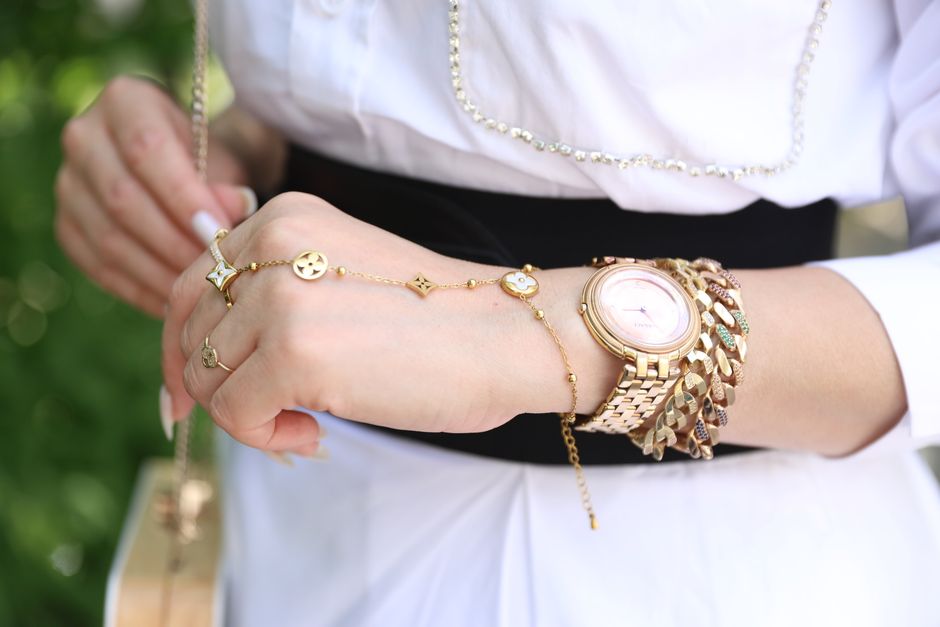
A gold chain bracelet womens shoppers can compare with confidence starts with four checks: confirm the karat and construction, compare the bracelet’s gold weight with the current spot price, measure the wrist for a comfortable fit, and match the chain style to daily use. Solid 14K has a higher share of alloy metals than 18K; both can suit everyday wear with proper care.
How much should a real gold bracelet cost?
There is no single fair price for a real gold bracelet: the amount depends on its gold-alloy weight, karat, workmanship, design, brand, and retail costs. Start by separating the price of the finished piece from the value of its gold content. Those are related figures, but they are not interchangeable.
Use this price-check sequence:
- Confirm the karat. The karat indicates the proportion of gold in the alloy. The Gemological Institute of America (GIA) identifies 14K as about 58% gold and 18K as 75% gold.
- Ask for the gold-alloy weight. A bracelet’s total weight is not necessarily all gold if it includes non-gold components. Ask the seller what weight and metal content the listing describes.
- Check the live spot price. Kitco publishes gold prices by weight, including grams and troy ounces. Because those prices change, check the figure on the day you compare or value the bracelet.
- Compare like with like. Ask what the quoted price includes, such as design and workmanship, then compare similar karat, weight, and construction rather than relying on a broad “gold bracelet” price.
A useful intrinsic-value estimate is gold-alloy weight multiplied by gold purity and the current spot price. That is a starting point, not a retail quote or guaranteed offer. Kitco notes that workmanship, brand, design, and retail costs affect the purchase price, while a buyer may offer less than the spot-derived melt value.
How much is a real gold chain bracelet worth?
A real gold chain bracelet is worth an amount that depends on its gold content and on what a buyer will pay for the finished piece. To estimate the gold component, use the bracelet’s gold-alloy weight, its purity, and the current spot price; do not treat that estimate as the bracelet’s guaranteed resale value.
For a quick comparison, 14K is roughly 58.3% gold and 18K is 75% gold, according to the purity figures summarized by Kitco and GIA. If two bracelets have the same gold-alloy weight, the 18K piece contains a greater proportion of gold. If their weights differ, compare both weight and purity before drawing a conclusion.
Then keep three values distinct: the retailer’s asking price for the finished design, an estimate of the gold’s intrinsic or melt value, and an actual resale or buyer offer. The sources do not publish a universal bracelet price or resale percentage. Ask the seller for the bracelet’s karat, gold weight, and construction, and check the live spot price rather than relying on an old price reference.
How can I tell whether a women's gold chain bracelet is solid gold or plated?
Check the karat and maker’s marks, read the metal description closely, and ask a jeweler to test the bracelet when the marks or claims do not settle the question. A stamp is a useful clue, not a complete guarantee: the FTC consumer guide notes that a karat mark alone is not required by law.
The FTC’s jewelry-buying guide advises looking for a karat mark and the maker’s name or U.S. registered trademark near it. A mark such as 585 corresponds to 58.5% gold, commonly associated with 14K; 750 corresponds to 75% gold, the 18K proportion described by GIA. Interpret the mark alongside the seller’s written description.
Know what the construction terms mean. The FTC guide describes gold-filled, gold overlay, and rolled-gold plate as a layer of at least 10K gold mechanically bonded to base metal. These terms do not mean a solid-gold bracelet. Gold electroplate and gold flash refer to thinner coatings, and plating can wear away over time; the guide says its longevity depends on wear frequency and coating thickness.
The FTC jewelry guidance says it is deceptive to misrepresent gold content, karat fineness, or the thickness, weight ratio, or application method of gold plating. Ask the seller to state whether the bracelet is solid gold, plated, or mechanically bonded, and what the stated karat applies to. If the marks are missing, unclear, or inconsistent with the listing, ask a jeweler about testing before you buy.
Should I choose a 14K or 18K gold chain bracelet for everyday wear?
Choose 14K if you prioritize a lower gold proportion and generally greater durability relative to higher-karat gold of the same color; choose 18K if a higher gold proportion is the priority and you are prepared to take care against scratches and dents. GIA says both 14K and 18K can be suitable for everyday wear, provided a gold piece is well crafted and cared for.
The FTC guide explains that 14K contains 14 parts gold and 10 parts other metals. GIA puts 14K at about 58% gold and 18K at 75%, with alloy composition affecting physical properties as well as color. The extra alloy content in 14K generally makes it more durable than higher-karat gold of the same color, while 18K contains more gold.
Neither karat settles every durability question. A chain’s link design, thickness, clasp, fit, and care also matter. GIA’s everyday-wear comparison discusses rings rather than chain bracelets, so it supports the metal tradeoff, not a specific ranking of bracelet links. A jeweler’s practical guide offers style-specific cautions, but it is not a controlled durability study.
| Option | Who it suits | Cost or gold content | Key limitation |
|---|---|---|---|
| Solid 14K gold | Someone balancing gold content with everyday durability | About 58% gold; price depends on weight, design, workmanship, brand, and retail costs | Less gold by proportion than 18K |
| Solid 18K gold | Someone prioritizing a higher gold proportion | 75% gold; price depends on weight, design, workmanship, brand, and retail costs | More prone to scratches and dents than lower-karat gold of the same color |
| Gold-filled, gold overlay, or rolled-gold plate | Someone considering a mechanically bonded gold layer over base metal | At least 10K gold in the layer; bracelet price not published | Not solid gold throughout |
| Gold electroplate or gold flash | Someone considering a thinner gold coating | Bracelet price and coating thickness not published | Plating wears over time; longevity depends on wear frequency and thickness |
How should you choose bracelet length and chain style?
Measure your wrist circumference, then add about 1.5–2 cm for comfortable drape. The Majestic Jewellery chain-bracelet guide gives 17–19 cm as a common adult women's length range, while noting that wrist measurements vary. Treat that range as a reference, not a substitute for measuring your own wrist.
Fit affects more than appearance. A very close fit can leave less room for comfortable movement, while extra drape may let the bracelet shift more. Choose the fit you want, then check that the clasp is manageable for you. Majestic describes lobster clasps as a secure, common choice for daily wear.
For link style, the same jeweler’s guide describes curb links as flat and relatively easy to repair, and belcher links as robust with straightforward link replacement. It cautions that herringbone and other flat woven chains can kink permanently, while very fine Figaro links may bend. Use those points as practical selection guidance, not as a universal laboratory ranking of every bracelet.
Paperclip links offer a style-led option. A trade supplier’s 2025 recap reported paperclip chains as a breakout design across necklaces, bracelets, and anklets, and reported frequent orders for charms including bows, birthstones, shells, crosses, and initials. These are supplier observations about fashion jewelry, not evidence that solid-gold paperclip bracelets outsold other styles. Match the design to how you plan to wear it, and ask about link construction and repair before purchase.
Frequently Asked Questions
What bracelet length should I buy for my wrist?
Measure your wrist circumference, then add about 1.5–2 cm for comfortable drape. A jeweler's guide gives 17–19 cm as a common adult women's bracelet-length range, but your own wrist measurement and preferred fit should decide.
Which gold chain styles are durable enough for daily wear?
A jeweler's guide describes curb links as flat and relatively easy to repair, and belcher links as robust with straightforward link replacement. It cautions that herringbone and other flat woven chains can kink permanently, and very fine Figaro links may bend; these are practical observations, not a controlled durability ranking.
What bracelets are trending now?
A trade supplier reported paperclip chains as a breakout design across bracelets and other jewelry in its 2025 sales observations. It also reported frequent orders for charms such as bows, birthstones, shells, crosses, and initials; this is supplier-reported fashion-jewelry activity, not an independent survey of solid-gold bracelet demand.
Sources
- Federal Trade Commission, eCFR 16 CFR § 23.3
- Federal Trade Commission, All That Glitters...How to Buy Jewelry
- Gemological Institute of America, Rose Gold vs. Yellow Gold
- Gemological Institute of America, The Best Ring Material for Everyday Wear
- Kitco, Gold Price Today
- Majestic Jewellery, Chain Bracelets: Links, Length & Clasps
- Wholesale Jewelry Website, 2025 Recap: A Breakthrough Year for the Fashion Jewelry Industry
Keep reading
Can You Lift Sagging Breasts or Reposition Nipples Without Surgery?
A clear guide to what exercise, bras, devices, implants, and mastopexy can and cannot do for sagging breasts and nipple position.

Can Rosemary Oil Help Hair Growth?
An evidence-led guide to rosemary oil for hair growth, scalp-safe dilution, realistic timelines, and when medical treatment is the better path.